Offsite Solutions
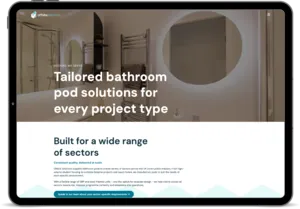
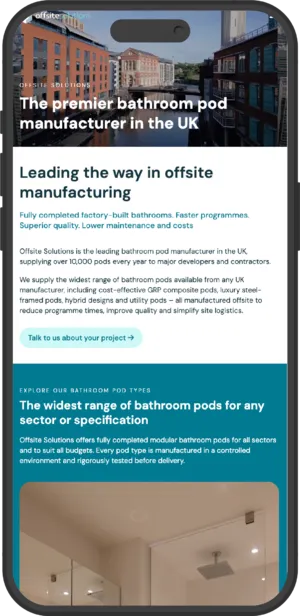
Offsite Solutions are the UK's leading bathroom pod manufacturer, shipping over 10,000 factory-built bathrooms a year to the contractors behind the country's biggest residential, hotel and healthcare schemes. We rebuilt their website around the way their buyers actually buy, which starts about a year before anyone asks for a quote.
Highbridge, Somerset Website design and build | SEO | Envelope
The situation
Offsite Solutions are the biggest name in British bathroom pods. If you've stayed in a newer hotel, lived in student accommodation or visited a modern hospital ward, there's a decent chance you've stood in one of their bathrooms without knowing it. They build them complete in a Somerset factory, test every one, wrap it, and crane it into buildings across the country. More than 10,000 a year. Over 100,000 since 2007, adding up to £400 million of sales, as part of a family-owned manufacturing group with sixty years of history, around 500 staff and annual sales around the £50 million mark.
And the product genuinely is the best in the category. Their panellised construction, with a separate floor and ceiling rather than a single moulding, lets them build things their competitors simply can't, and their GRP pods carry a fifty year guarantee. This is engineering-led British manufacturing at serious scale.
So what's the problem? The problem is how their product gets bought.
Bathroom pods are bought through tender, and tenders are run by cost consultants whose entire job is to bring the number down. By the time the contract is awarded, the decision has become a decision about price. Quality mattered enormously about nine months earlier, to the architect who specified the scheme, but the architect isn't in the room any more. So the best product in the category spends its life being compared on cost against products that aren't as good, by people paid to not care.
Which means their website was never going to be a shop window. Its job is to reach the architect and the specifier early, while the specification is still being written, and to arm the people who'll later have to defend choosing quality when the budget pressure arrives. That's a much more interesting brief than "make us a nice site," and it shaped every decision that followed.
What had to be true
Three questions sat underneath the whole project. How do you reach a specifier who has zero interest in talking to a salesperson? What do you keep from twenty years of website, and what do you let go? And what does an architect actually need from you at four o'clock on a Thursday afternoon?
The decisions
A leaner site, built from evidence
Twenty years of website accumulates a lot of pages, and Offsite came into the project wanting a much tighter, more focused site. We agreed, but nobody should delete two decades of content on instinct alone, so we ran the entire existing sitemap against real search data first to see what was actually earning its keep. The answer was almost nothing, with one exception, and rather than keep that page limping along on its own we folded its content into a stronger one that could carry it properly.
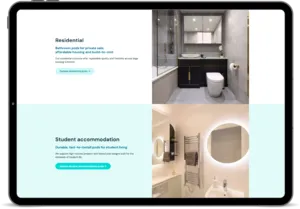
The result is a leaner site where every page has a job: pod types, sectors and services each with their own clear branch, because a hotel developer and an MOD contractor arrive with completely different questions and shouldn't have to translate someone else's org chart to get answers. And a full redirect map underneath it all, so twenty years of Google history moved across without a scratch.
The deepest technical library in the category, served straight
Here's the thing an architect actually wants at four o'clock on a Thursday: the drawing. Not a brochure about the drawing, not a form to fill in before seeing the drawing. The drawing itself, in the format their software opens.
Offsite have the deepest CAD and BIM library of any manufacturer in their category, and the new site serves all 141 files natively, as the PDFs, DWGs and IFC models that drop straight into a specifier's own work. It's the single best reason for a specifier to land on the site, and the best reason for them to remember exactly where they got it when the tender comes round. Generosity as strategy, backed by genuine engineering depth that competitors would struggle to match.
Two forms for two very different moments
An architect with a question about floor build-up is at the very start of a journey that runs the better part of a year. A contractor pricing a live scheme is at the end of it. Treating those two people the same is how websites quietly lose both, so the new site doesn't.
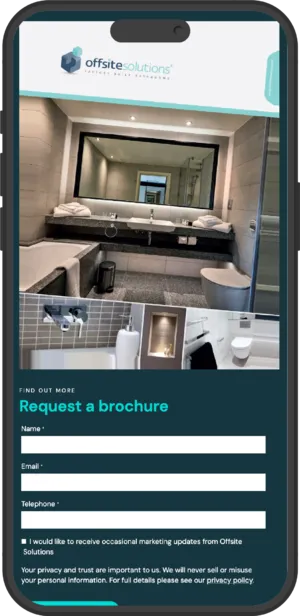
The quote form is properly qualified, asking pod quantity, build type and project stage, so Offsite's sales team can respond like the specialists they are. The contact form deliberately asks almost nothing, because someone nine months from buying just wants an answer, not a sales process. Two moments, two doors, no pretending they're the same thing.
Typography that respects a technical reader
There's a version of this site set like a glossy brochure, with justified text and flush edges down both sides of every block. It looks tidy in a mock-up. We set it the other way, ragged right throughout, and the reasoning is worth sharing because it's exactly the sort of invisible decision this audience benefits from. Justified text tears rivers of white space through paragraphs and makes text measurably harder to scan, and this site's reader is a technical professional hunting for one number on a lunch break. Everything on the page defers to that reader, right down to the edges of the paragraphs.
What’s live now?
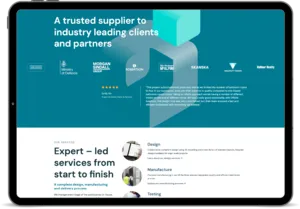
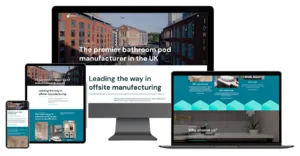
A site with the confidence to match the company. The numbers do the talking, because Offsite's numbers can: 100,000 pods, £400 million of sales, sixty years of group heritage, a fifty year guarantee, and a client roster drawn from the biggest names in British construction. In a category where everyone claims premium, they're the ones who can prove it, and the site is built so the proof is never more than a click away.
The category's deepest technical library, free and open, putting real engineering substance in front of the people who write specifications.
And a quote form that hands their sales team qualified, detailed enquiries rather than mystery phone numbers.